Are you planning a civil wedding in Italy and wondering how a foreign couple can get legally married in Sicily?
For an American, British, Canadian or international couple, getting married in Sicily can feel like the perfect combination of romance and meaning. But when the wedding is legally celebrated in Italy, there is another side to consider: documents, consulates, translations, the local “Comune” and requirements that may change according to your nationality.
The good news is that foreign couples can get married legally in Italy.
However, there is no single checklist that works for everyone. The documents and procedure can vary according to your citizenship, personal circumstances and the municipality where you want to celebrate the marriage.
That is why understanding the process before choosing your wedding date and venue can make everything much easier.
In this guide, we will look at:
- Whether a foreign couple can legally get married in Sicily
- Which documents may be required
- What “Nulla Osta, apostille and translations” actually mean
- The difference between a civil, religious and symbolic ceremony
- Where a civil wedding can take place in Sicily
- How far in advance you should start
- What changes according to nationality
- How the relationship with the Comune works
- What a wedding planner can coordinate
- What happens if you want your legal ceremony to take place in a wedding venue rather than in a town hall
Frequently Asked Questions About Civil Weddings in Italy
The aim is to give you a clear starting point, without making the legal process sound more complicated than it needs to be.
Important: the requirements for a legal marriage can change according to nationality, personal circumstances and municipality. Always confirm the current requirements with the relevant Italian Comune, embassy or consulate before making final arrangements.
Can foreign couples get legally married in Sicily?
Yes. You do not necessarily have to be an Italian citizen or live in Italy to get married here.
For a foreign citizen, however, Italian law requires documentation demonstrating that there is no legal impediment to the marriage. Article 116 of the Italian Civil Code is the reference point for foreign citizens wishing to marry in Italy.
The practical procedure then depends on the nationality of each partner.
This is one of the first things international couples should understand.
An American couple does not necessarily follow the same process as a British couple.
A German or Spanish couple may have access to a multilingual certificate under the 1980 Munich Convention, while other nationalities may need a Nulla Osta or equivalent certificate, together with legalisation and translation.
So, before downloading a generic wedding checklist from the internet, start with a much simpler question:
What does my country require in order for me to marry in Italy?
That answer will determine much of what happens next.
What documents do you need for a civil wedding in Italy?
There is no universal list for every foreign couple.
In general, you should expect to provide valid identification and documentation proving your legal capacity to marry.
Depending on your nationality and circumstances, additional documents may include birth certificates, evidence relating to a previous marriage, certificates of no impediment and other civil-status documents.
For example, the Italian Consulate General in Sydney explains that the Comune may request additional documents such as birth certificates, certificates of unmarried status, divorce documentation or evidence of widowhood depending on the circumstances.
This is why it is better to think of your paperwork as a personal document file, rather than a standard package that every couple receives.
Your file may include:
- passport or other valid identification;
- Nulla Osta or equivalent document;
- certificate of no impediment or marriage capacity, depending on nationality;
- documents relating to previous marriages, where applicable;
- translations into Italian, where required;
- apostille or legalisation, where required.
The exact combination needs to be confirmed for your nationality and the Comune where the wedding will take place.
What is a nulla osta?
The expression Nulla Osta literally refers to a declaration that there is no obstacle to something proceeding.
For marriage, it is the documentation used to demonstrate that there is no legal impediment to the foreign citizen marrying under the applicable law.
However, there is an important detail that is often lost in online wedding guides.
Not every foreign citizen obtains a document called “Nulla Osta” in exactly the same way.
The Italian Consulate General in Sydney, for example, distinguishes between a multilingual certificate of matrimonial capacity issued under the 1980 Munich Convention and a certificate of no impediment or Nulla Osta issued by the competent authority.
Therefore, the safest approach is to establish:
1. which document your nationality requires;
2. who is authorised to issue it;
3. whether it needs legalisation;
4. whether it needs an apostille;
5. whether it needs an Italian translation;
6. whether the document has a validity period.
This is also where a local wedding planner can become extremely useful: not by replacing the authorities, but by helping you understand the sequence of the administrative process and coordinate it with the rest of the wedding.
Apostille, legalisation and Italian translations
These three words often appear together when couples begin researching a civil wedding in Italy.
They do not mean the same thing.
What is an Apostille?
An apostille is a form of authentication used between countries that participate in the Hague Apostille Convention.
Its purpose is to authenticate the origin of a public document so that it can be recognised in another country.
But an apostille is not automatically required for every document.
International conventions can provide exemptions, while different documents can follow different procedures.
For example, the Italian Consulate General in Sydney explains that certificates of matrimonial capacity issued by countries participating in the 1980 Munich Convention are exempt from legalisation and translation.
So do not assume that every certificate you obtain in your home country needs an apostille.
First ask the competent authority.
Do foreign documents need to be translated?
They may.
If a document is issued in a language other than Italian, the Italian authority handling the marriage may require an Italian translation and, depending on the circumstances, certification of that translation.
The procedure can differ according to the country in which the document was issued and the legal status of the translator.
For example, Italian consular guidance explains that certificates of no impediment may need to be translated into Italian, with specific rules concerning certification of the translation.
This is why it is better to verify the requirements before paying for translations.
A document translated in the wrong way can create another administrative step rather than solving the first one.
Civil, religious or symbolic ceremony: what’s the difference?
Before thinking about paperwork, it is worth deciding what kind of ceremony you actually want.
A civil ceremony is the legal marriage performed according to Italian civil law.
A religious ceremony follows the requirements of the relevant religious authority and, depending on the circumstances, may also have civil effects.
A symbolic ceremony is different.
It is a personal celebration of the couple’s commitment, but it does not itself create the legal marriage.
This distinction is particularly important for destination weddings.
Some couples want the entire legal experience to happen in Sicily.
They want to sign the documents, exchange vows and become legally married during their Italian celebration.
Others prefer to complete the legal paperwork in their home country and then have a symbolic ceremony in Sicily.
There is no right or wrong choice.
The important thing is to know which option you are choosing before you book the venue and start organising the ceremony.
Where can a civil wedding take place in Sicily?
This is where the legal side of the wedding becomes particularly interesting.
Many couples imagine that a civil wedding has to happen inside a traditional town hall.
That is not necessarily the only possibility.
Municipalities can establish or authorise specific locations for civil ceremonies, so the possibilities can include historic buildings, gardens or other officially designated spaces, depending on local rules.
However, there is a very important distinction:
A wedding venue is not automatically a legal civil ceremony venue.
A beautiful villa may be perfect for your reception but not authorised for the legal ceremony.
Another location may have the necessary municipal authorisation.
Therefore, if your dream is to exchange your vows overlooking the sea, in a historic Sicilian building or surrounded by olive trees, check the legal status of the location before assuming that the ceremony can take place there.
How does the Comune work?
The Comune is the local municipality responsible for the civil-status procedure.
For an international couple, this relationship is essential.
The municipality is the authority that handles the civil marriage procedure and confirms which documentation is required for the specific marriage.
The Italian Ministry of Foreign Affairs and Italian consular authorities repeatedly direct couples towards the municipality where the marriage will take place for confirmation of the applicable requirements.
This is particularly important because the practical process can differ from one municipality to another.
There may be different appointment procedures, fees, documentation requests and arrangements for ceremonies in authorised locations.
So, while an online guide can help you understand the terminology, the Comune is the place where your specific procedure is confirmed.
That is why contacting the municipality early is so valuable.
How far in advance should you start?
There is no universal deadline for every foreign couple.
The right timing depends on your nationality, the documents required, the authorities involved and the municipality where you will marry.
Some documents also have validity periods.
For example, the Italian Consulate General in San Francisco states that the “Atto Notorio” issued for US citizens is valid for 90 days, meaning the marriage must take place within that period.
This is a good example of why timing matters.
A document should not necessarily be requested as soon as you become engaged if its validity is limited. At the same time, you should not wait until the last few weeks.
A sensible approach is to start researching the legal requirements **several months before the wedding**, then establish the exact timing with the competent authorities.
A practical sequence is:
nationality → documents → legalisation/translation → Comune → ceremony → wedding day
Once you know this sequence, the process becomes much easier to manage.
What changes according to your nationality?
This is probably the most important section for an international couple.
There is no single “foreign wedding procedure”.
The requirements can be substantially different.
US citizens have a specific process.
According to the Italian Consulate General in San Francisco, US citizens wishing to marry in Italy need an Atto Notorio and a sworn statement or affidavit, while additional documentation may be required in cases involving previous marriages.
The consulate also specifies that the Atto Notorio it issues is valid for 90 days.
This means an American couple should not simply follow a checklist created for British or European couples.
The process needs to be organised according to the US-specific requirements.
requirements for US citizens getting married in Italy
British citizens have their own procedure.
The Italian Consulate in Manchester explains that British citizens may need a Certificate of No Impediment, issued within a specific period, together with apostille and translation requirements and a statutory declaration.
Canadian Couples and Other Nationalities
Canadian couples and couples from other countries should follow the procedure applicable to their own nationality.
This sounds obvious, but it is one of the easiest mistakes to make when planning a destination wedding.
If your friends from the United States needed one document, that does not automatically mean you need the same document.
If another couple from Europe was able to use a multilingual certificate, that does not automatically mean the same option is available to you.
Your nationality comes first.
What if one or both partners have been married before?
Previous marriages can add another layer to the paperwork.
If one partner is divorced or widowed, the relevant authorities may request documents proving that the previous marriage has legally ended.
For US citizens, for example, the Italian Consulate General in San Francisco specifically lists final divorce decrees, annulment decrees or the death certificate of a former spouse among possible additional documents, with apostille and certified Italian translation where applicable.
This is another reason to start the process early.
A previous marriage is not necessarily a problem.
It simply means that the document trail may be more extensive.
What if you want the legal ceremony in a cedding venue?
This is one of the most common questions from couples who dream of a truly Sicilian wedding.
Perhaps you have found a historic masseria.
Maybe you want to exchange vows in a Mediterranean garden.
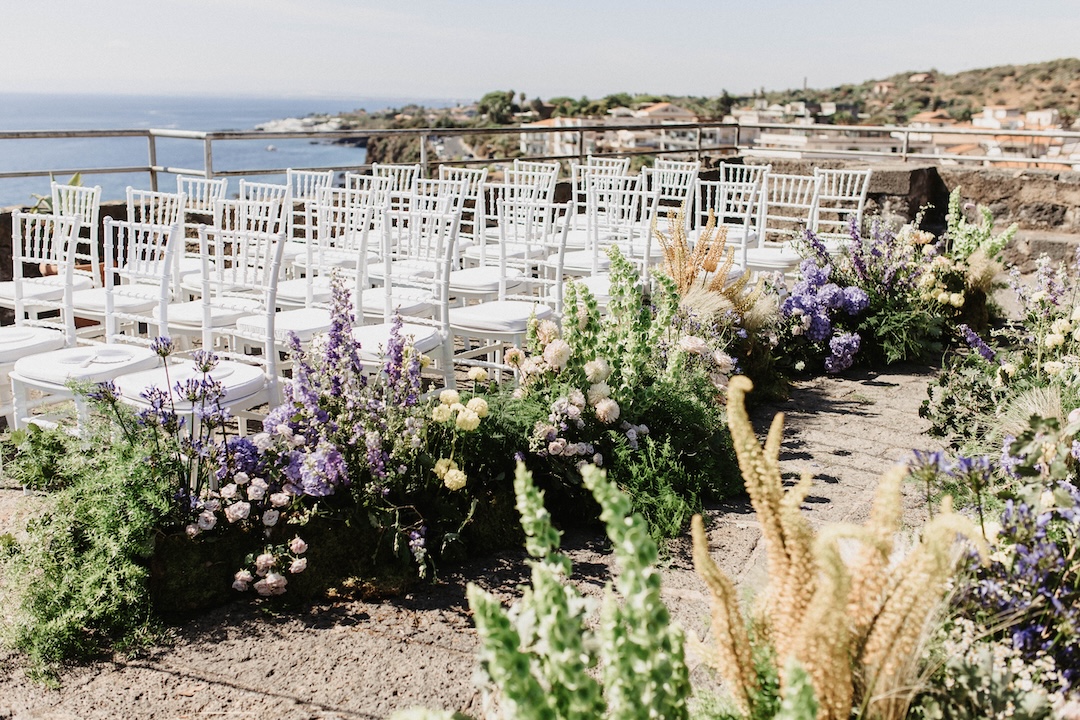
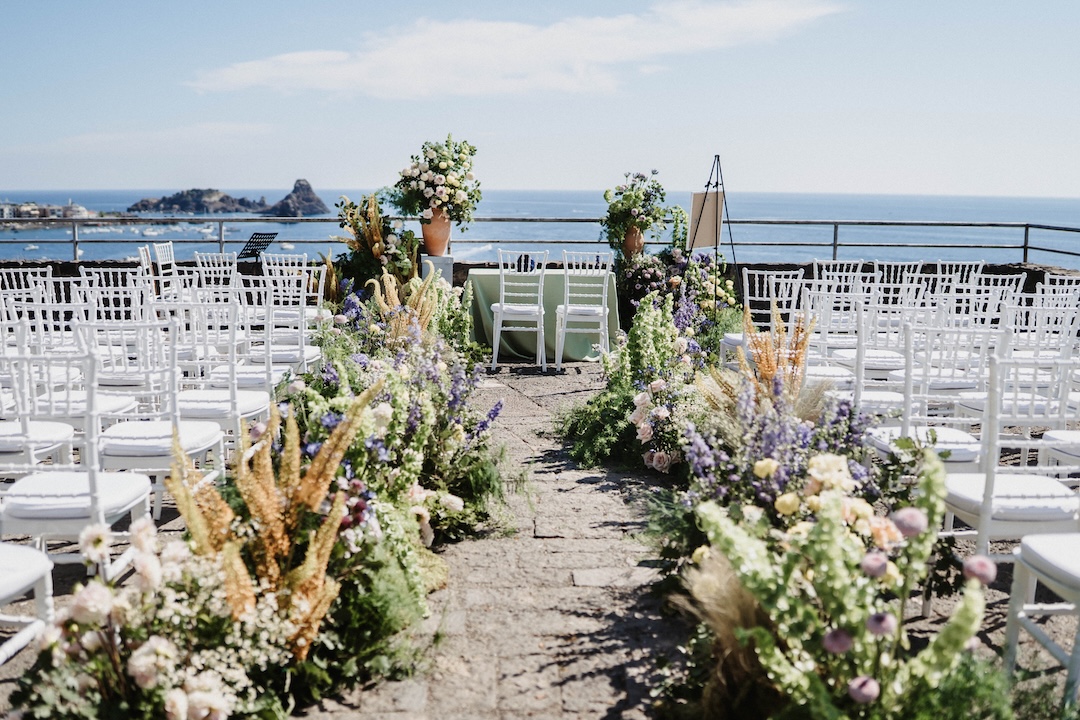
Or perhaps your ideal ceremony is on a terrace overlooking the sea.
The first thing to establish is whether the chosen location is authorised for civil ceremonies by the relevant municipality.
If it is, your legal ceremony and your wedding celebration may be combined in one location.
If it is not, you may choose to complete the legal ceremony at the Comune and then hold the main celebration at your preferred venue.
For some couples, this is actually the easier solution.
The legal moment can be intimate and straightforward, while the main ceremony and celebration can be designed entirely around the couple’s personality.
See also: all-inclusive wedding packages in Sicily

What does a wedding planner coordinate?
For a couple living abroad, the challenge is rarely one single task.
It is the number of things that have to happen at the right time.
You may be speaking with a municipality, a consulate, a translator, a venue, a caterer, a photographer and your guests, all while living in another country.
A wedding planner can help bring those moving parts together.
Depending on the service, this can include:
- coordinating communication with the Comune;
- creating a timeline for the administrative steps;
- helping the couple understand which documents need attention;
- coordinating translators or interpreters;
- communicating with the venue;
- organising ceremony logistics;
- coordinating suppliers;
- managing transportation and guest logistics;
- making sure the legal ceremony fits naturally into the wedding-day schedule.
The planner does not replace the official authority.
The Comune, embassy or consulate remains the source of the legal requirements.
The planner’s role is to help the couple navigate the practical side and make sure that the administrative process does not become disconnected from the wedding itself.
For an international couple, that local presence can make a considerable difference.
Civil wedding or symbolic ceremony in Sicily?
Sometimes the easiest decision is not about paperwork at all.
It is about what you want the wedding day to feel like.
If you complete the legal marriage in your home country, you can come to Sicily and have a symbolic ceremony designed entirely around your relationship.
There is no need for the ceremony itself to create the legal marriage, which means you can focus on the emotional and personal side.
You might exchange vows in a garden, beside the sea, among olive trees or in a historic setting.
On the other hand, if having the legal ceremony in Sicily is important to you, then completing the Italian civil process can make the wedding feel even more connected to the country where you have chosen to celebrate.
Both options can create a beautiful destination wedding.
They simply offer different experiences.
Planning a civil wedding in Sicily from abroad
Planning from another country can make even simple decisions feel more complicated.
- You may not know how Italian municipalities work,
- may not be familiar with the terminology.
- may receive documents in a language you do not speak.
And, at the same time, you are trying to choose a venue, organise accommodation and create an experience for your family and friends.
That is why the legal process should be considered from the beginning rather than added to the wedding checklist at the end.
Start with your nationality.
Then identify the documents.
After that, establish the legalisation and translation requirements.
Finally, contact the Comune where you want to marry and confirm the procedure.
Once these foundations are clear, you can concentrate on the part that brought you to Sicily in the first place.
The wedding itself.
Your Wedding Should Feel Like a Wedding, Not a Paperwork Exercise
A civil wedding in Italy can seem complicated when you first start reading about Nulla Osta, apostilles, translations and municipal procedures.
But you do not need to understand everything at once.
You need to understand what applies to you.
- For one couple, the process may involve a Nulla Osta.
- another, it may involve a certificate of matrimonial capacity.
- another, specific documents issued by a consulate.
The key is to avoid generic assumptions and establish your requirements with the relevant authorities.
Then the paperwork becomes one part of the journey rather than the story of your wedding.
And once that part is organised, you can start thinking about the things that really make your celebration yours: the setting, the atmosphere, the food, the flowers, the people you love and the Sicily you want them to experience with you.
Ready to start planning your wedding in Sicily?
If you are planning a civil wedding in Italy from abroad, you do not have to organise every part of the journey alone.
From finding the right setting to coordinating suppliers, logistics and the wedding day itself, local support can help turn a complicated destination wedding into an experience that feels much more manageable.
Looking for the right setting for your wedding? Explore the Wedding Venues in Sicily and start discovering the possibilities.
Your wedding day should be about the two of you, not about worrying whether one document has the right stamp.
If you are dreaming of a civil wedding in Italy, Sicily can offer the setting, atmosphere and sense of place that make a destination wedding truly memorable.
The legal process simply needs to be approached carefully and early.
Ready to start?
Request your personalised wedding proposal and tell Valentina about the wedding you are imagining in Sicily.